
Rent collection starts with a scheduled obligation, but it does not end when someone enters a payment. The team must know which obligation the money settles, whether anything remains outstanding and what evidence supports the receipt.
The AmlakOS demo separates Collections from Payments. We use those actual screens to explain the distinction. All properties and amounts are synthetic; this is an operational software walkthrough, not a statement about real rental income.
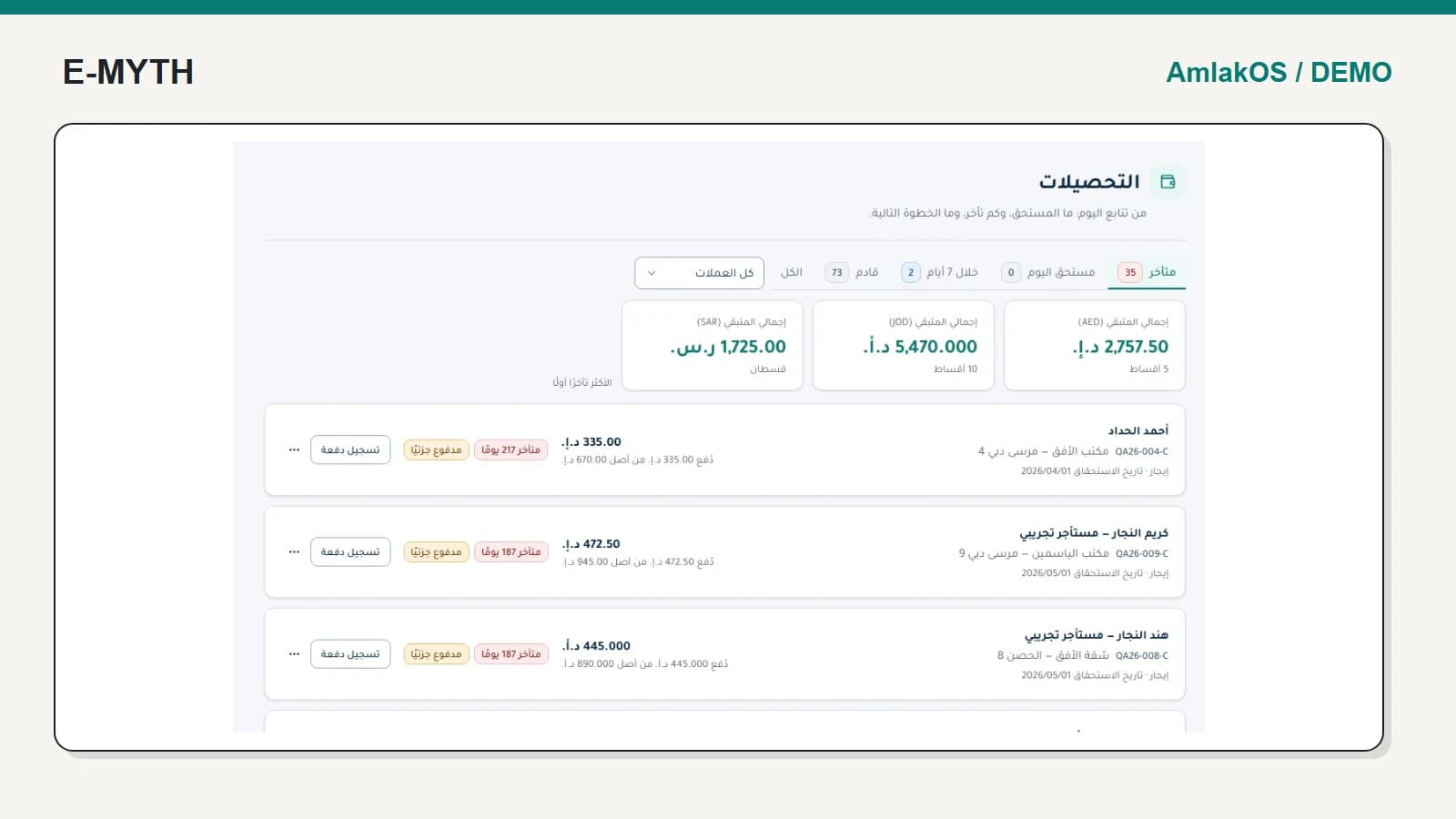
Use Collections to decide whom to follow up
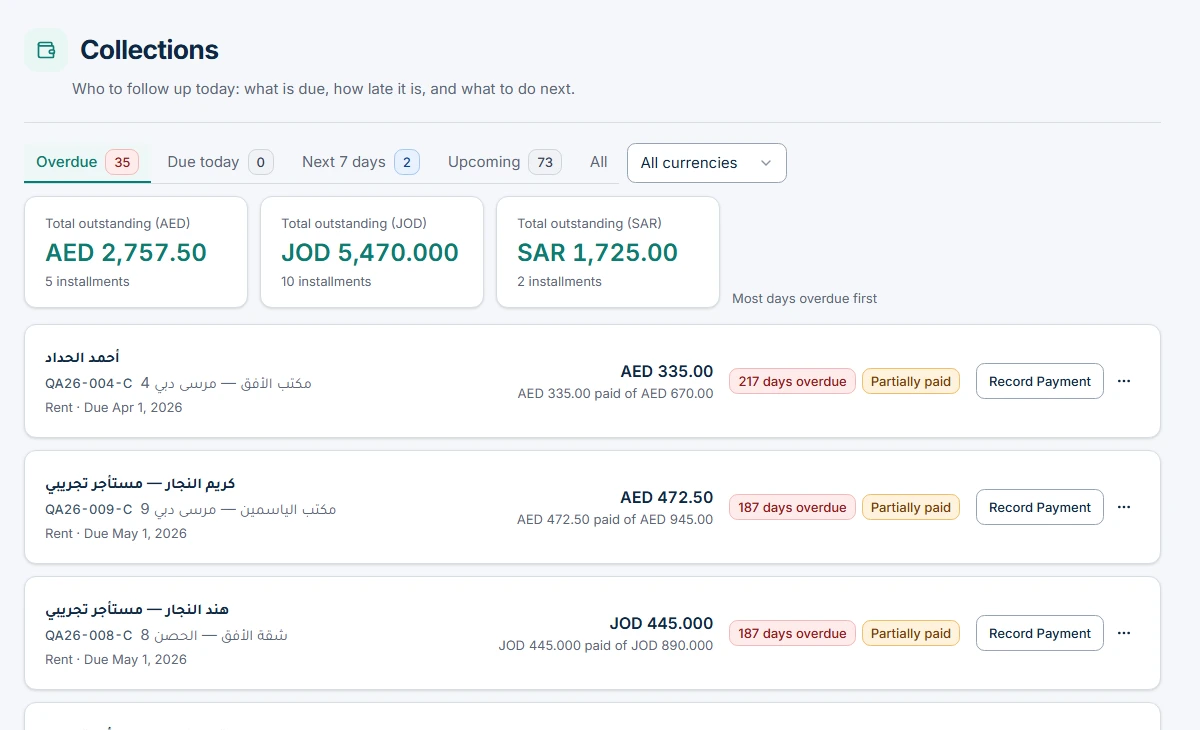
The collection workspace asks what is due, how late it is and what action is available. It is the right starting point for the employee organising follow-ups. The relevant context includes contract, payer, due date, currency and remaining amount.
 View the full-size screen ↗
Open a representative contract and compare the schedule with the collection entry. Include a future installment and a partially paid installment. A useful result explains the remaining amount rather than showing only an original total or a general “late” label.
Use Payments to explain what arrived
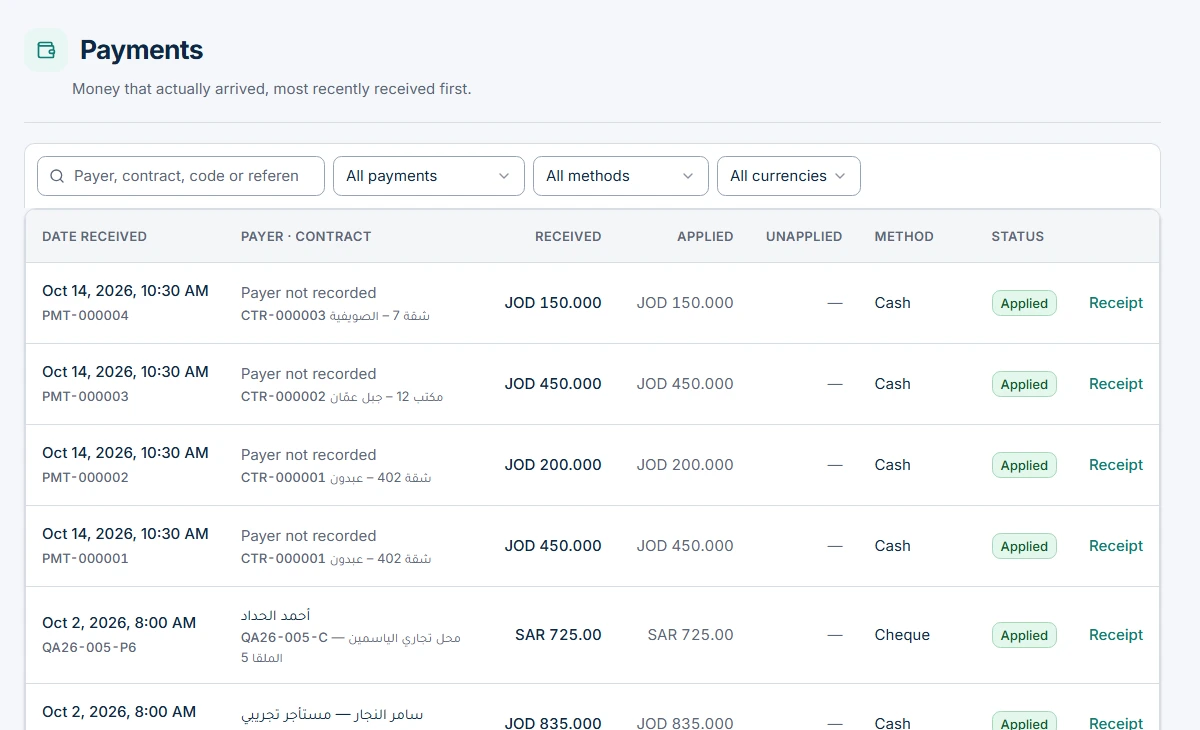
The payment workspace starts from received money. It shows amount, applied amount, remaining unapplied money where relevant, method and receipt. This is a different view of the business from the queue of obligations.
 View the full-size screen ↗
An unapplied payment should not silently settle whichever installment happens to appear first. Agree allocation rules, who may apply money and how a mistaken allocation is corrected. In the implementation, reversals and unapplied funds are treated separately from applied collections.
Keep the date and the event behind each report
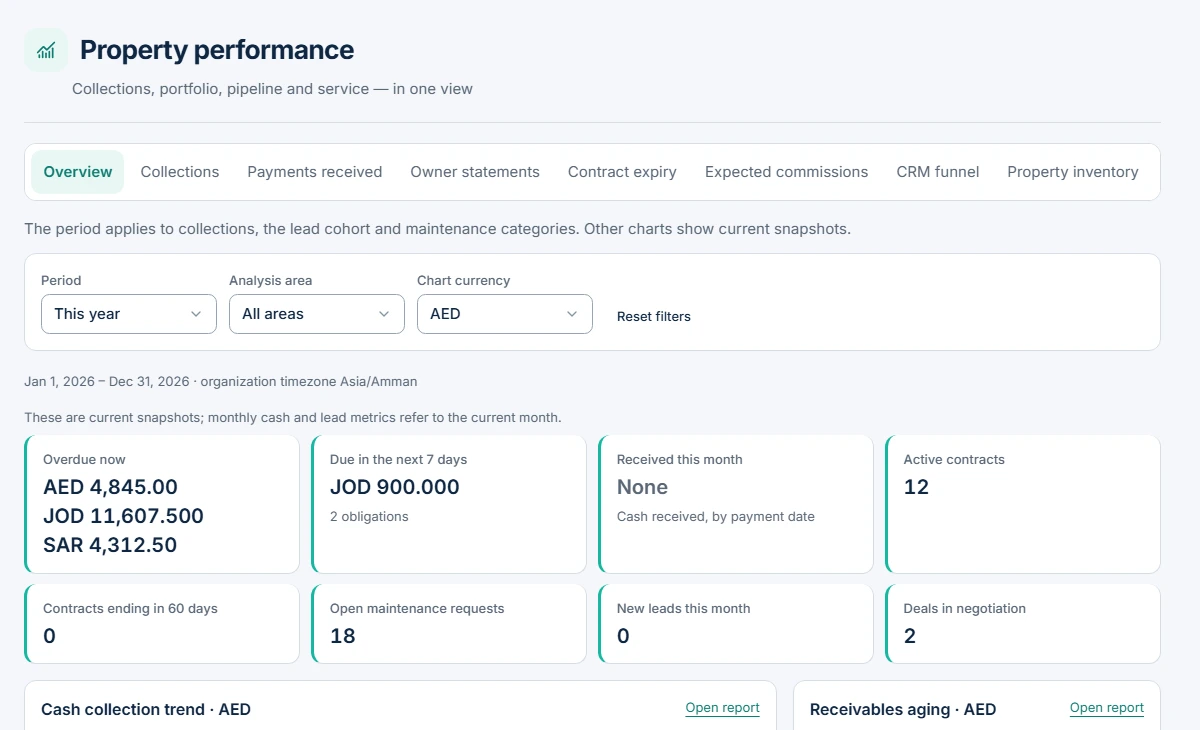
“Received this month” follows payment dates. “Overdue now” describes a current position. A contract signed during the month is neither of those. Combining these measures into one chart without defining them leads to arguments that are really about scope.
 View the full-size screen ↗
Choose one number and reconcile it to the underlying records. Check the organization timezone and date boundaries. The owner portal guide explains why a property owner's statement should also use an explicit scope and period.
Treat ended contracts and corrections deliberately
An ended contract can leave financial questions that are different from active-schedule collection. The project has a specialized settlement-review capability with production activation restrictions. Do not promise that a particular settlement decision is live merely because a review screen exists.
Define the treatment required for your deployment with the responsible specialists, then test it. This article does not prescribe legal collectibility or accounting policy. It identifies the software states that must be reconciled under the policy you adopt.
Do reminders and online payments finish the process?
No. A reminder can fail, and a payment link can remain unpaid. External provider acceptance and allocation to the correct obligation must be verified separately. Live payment processing was not verified in this demo. The automation guide shows why message creation, sending and delivery are different states.
A focused acceptance exercise
Start with one active contract and two installments. Record a partial test payment, inspect the remaining amount, open its receipt, then perform an authorised correction. Compare Collections, Payments and the relevant report. Repeat with a second currency without merging their totals. If the team can explain every difference, the demonstration is more meaningful than a high-level financial dashboard.
Continue with the workflow you need
- Property management software: what should it connect?
- Real estate CRM: from enquiry and viewing to contract
- Property maintenance: from request to visit outcome
- Owner and tenant portals: access without exposing everything
- Property automation: reminders, delivery status and integrations
How this walkthrough was prepared
We reviewed the AmlakOS implementation and opened its local demo on November 4, 2026. Screens show actual interfaces with synthetic fixtures, cropped to the relevant area without changing their content. Interface states alone do not establish customer outcomes or successful external delivery.
More perspectives