
“The customer brought it back” does not answer four important questions: was the return authorised, what condition was the product in, where should it go, and what financial action is owed? Treating all four as a single checkbox can put damaged goods back on sale or issue an unexplained credit.
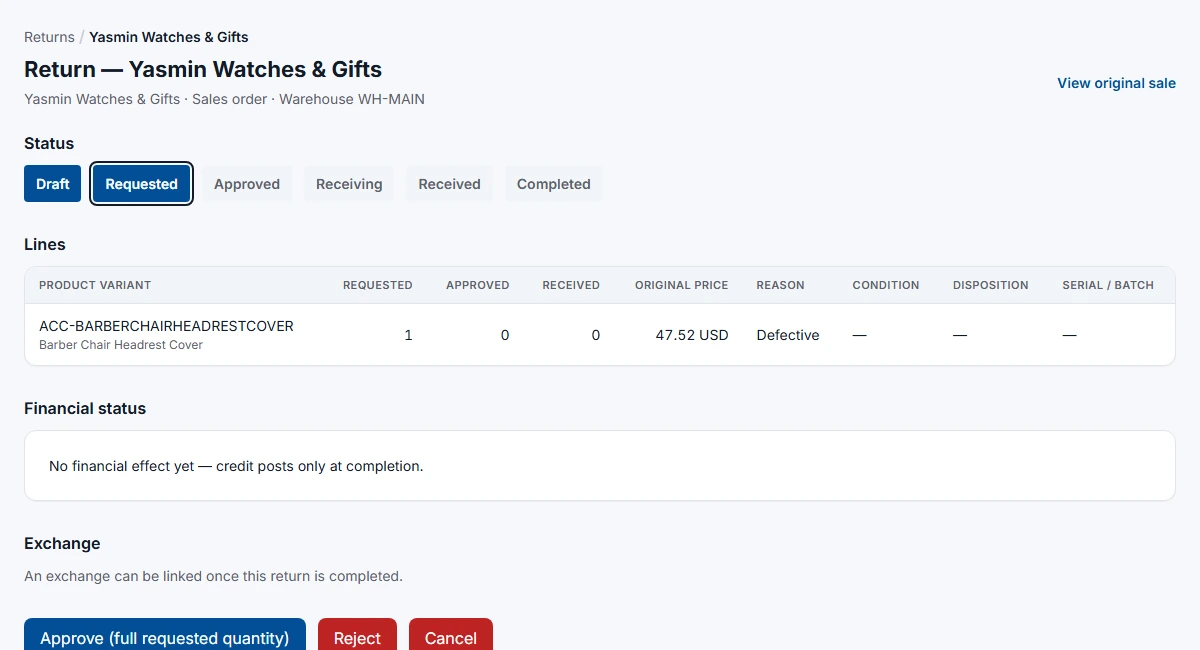
The local WholesaleOS demo lets us inspect the return decision and a received return. These are synthetic records at different stages, not before-and-after captures of one customer case.
Start with the original sale and requested quantities
A return should identify the customer, channel and original sale before staff decide what can be accepted. The review needs requested and approved quantities and a reason. A counter-sale receipt and a wholesale delivery may provide different starting references.
 View the full-size screen ↗
Agree your return window, condition policy and approval roles as business requirements. The software can enforce the configured workflow, but it cannot decide a commercial policy that the company has not defined. Test a quantity above the original delivered amount and an unauthorised approval in a separate test environment.
Receiving still needs a condition and disposition
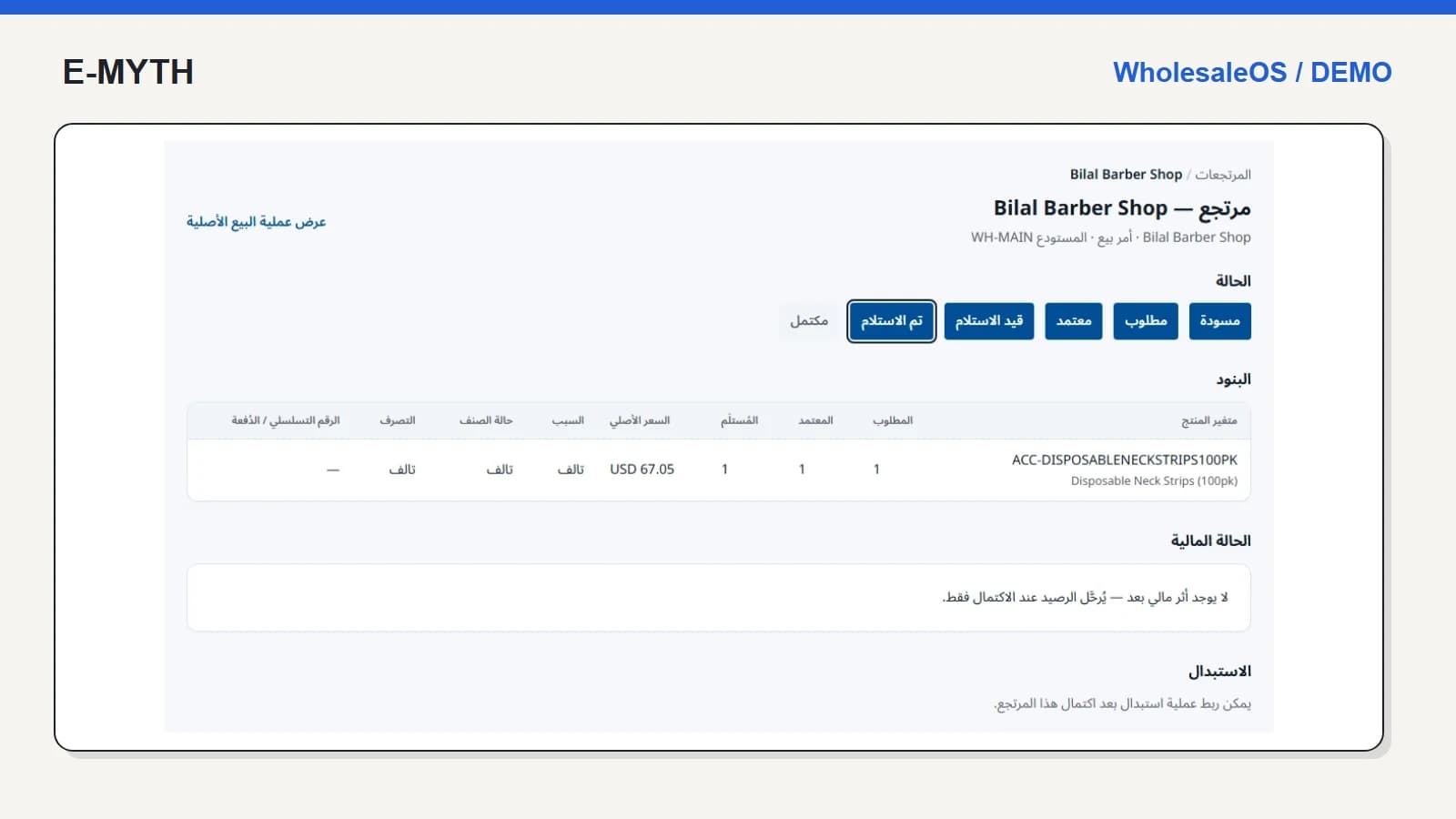
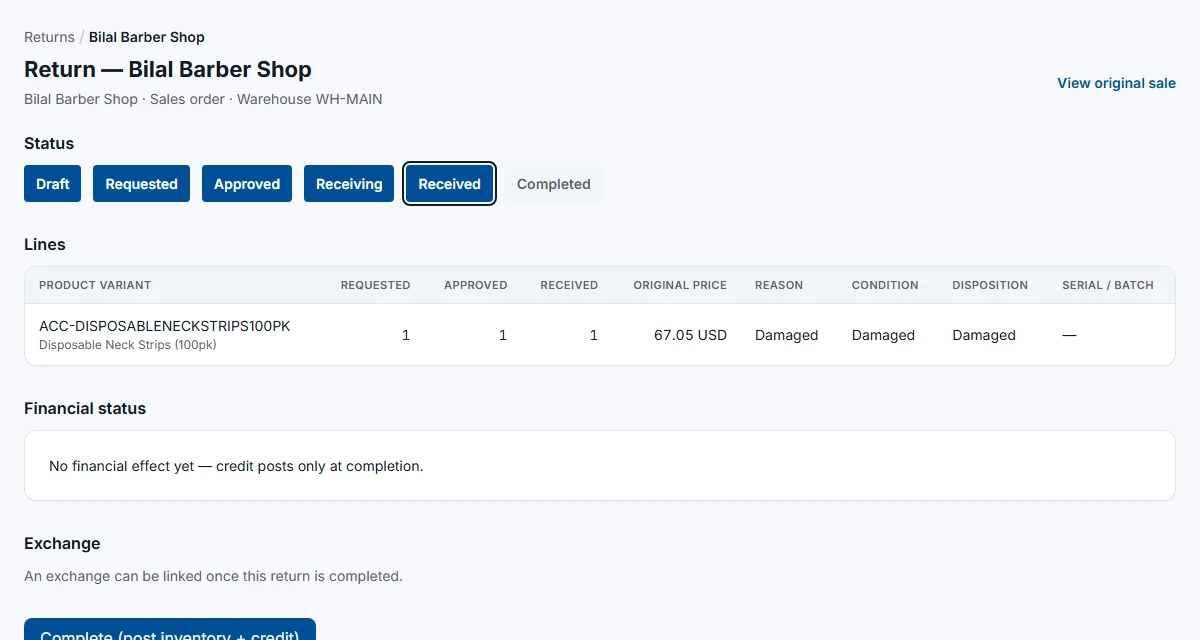
The next example is a different, already received return. Its single unit is marked damaged, with damaged disposition. That distinction matters: receiving goods at the warehouse does not automatically make them available for resale.
 View the full-size screen ↗
Follow the item to its intended destination and make the decision visible to the next employee. A restockable item, a damaged item and an item awaiting inspection should not be casually combined just because all three crossed the warehouse door.
Completion, credit and cash refund are separate concepts
The captured screen offers completion that posts inventory and credit. It also says an exchange can be linked once the return is completed. This makes the sequence explicit; it does not prove that money has already been handed back or transferred externally.
After completing a test return, inspect the customer account and the stock record. If cash reimbursement is required, verify the refund method, authorisation and recorded outcome separately. Repeating an action should not create a second credit unnoticed.
An exchange must identify both sides
If the customer receives a replacement product, preserve the relationship between the returned item and replacement sale. Otherwise the team may know what came back without knowing what went out. Include price differences, different variants and unavailable replacements in your acceptance scenarios.
Warranty service follows another question
Warranty asks what happens to an item under service: review, repair, replacement, refund, return to the customer or rejection. WholesaleOS has a separate warranty-case area with status and resolution notes. A case entering service is not evidence of a sale refund or of a completed repair.
For a useful warranty demonstration, select one product with its serial identity and a coherent service history. Follow the diagnosis, resolution decision and hand-back record. Keep responsibility for approving a replacement or refund distinct from permission to update a technician's notes.
What should the business sign off?
- Return eligibility, approval authority and required evidence.
- Item condition and warehouse disposition, including damaged stock.
- The point at which credit is posted and who can issue a refund.
- A linked exchange with a different price or an unavailable replacement.
- Warranty closure notes and the customer's hand-back record.
Use one ordinary return and one awkward exception when reviewing scope. That is usually where gaps between sales, warehouse and finance become visible.
Continue with the workflow you need
- Choosing wholesale inventory software: a practical guide
- Sales and inventory: pricing, reservations and delivery
- Warehouse stock control: counts, transfers and expiry
- Purchase orders and partial receiving: a warehouse walkthrough
- Credit sales and collections: reading a customer statement
How this walkthrough was prepared
We reviewed the WholesaleOS implementation and opened its local demo on November 4, 2026. Screens show actual interfaces with synthetic fixtures, cropped to the relevant area without changing their content. Interface states alone do not establish customer outcomes or successful external delivery.
More perspectives